
Full Guide To Best CS2 Settings for Low-End PC
Contents

The release of CS2 caused significant hype and buzz across the community. Although Valve preserved player’s inventories and in-game achievements, Counter-Strike transitioned to the Source 2 engine. This significantly improved the game's graphics but also increased the technical demands on gaming rigs. Naturally, this transition affected CS2 settings for low-end PCs, which now differ from those used in the Global Offensive version. This article will guide you through the maze of CS2 settings for a low-end PC and laptops so you can launch and try the latest Counter-Strike edition.
Minimum Requirements
Valve has updated the minimum system requirements for CS2, which are as follows:
- OS: Windows 10.
- Processor: 4 cores (Intel Core i5 750/i3-4340 or AMD Phenom II X4 955/FX-4300).
- Memory: 8 GB RAM.
- Graphics: 1Gb Video card supporting Shader Model 5.0 (NVIDIA GeForce GTX 660 / AMD Radeon HD 7850).
- DirectX: Version 11.
- Storage: 85 GB of available hard disk space.

However, having hardware that meets these requirements does not guarantee a comfortable gaming experience. Even optimized CS2 settings for a potato PC are unlikely to deliver more than 30–40 FPS, which can drop to 10 or lower in the smokes, near water, or during intense skirmishes. Still, this setup serves as an entry ticket to Counter-Strike 2.
So, if upgrading your gaming PC isn’t an option, you’ll need to dig deep into CS2 low-end PC settings to join the community and enjoy modern Counter-Strike.
Best General CS2 Settings for a Low PC
So, let's break down the best settings for Counter-Strike 2, starting with the general options. These settings control the game’s core aspects, such as video, audio, and controls.
Video

The video settings have the greatest impact on performance, and older rigs struggle the most here. Let's take a look at the best video settings for CS2 because incorrect configuration can directly affect the FPS and overall gameplay.
- Display mode: Fullscreen.
In fullscreen mode, you can see a slight increase in FPS. However, if you use monitor calibration software or hardware (for example, a special program or device to adjust the colors as closely as possible), the calibration profile may reset when you launch any fullscreen application, as such applications apply their own profiles.
- Aspect Ratio: 16:9.
This aspect ratio depends solely on your monitor’s dimensions. 16:9 is the most common option. Some players choose the 4:3 aspect ratio and stretch the image to make the enemy models appear larger.
- Resolution: 1176x664.
The higher the resolution, the sharper the image, but lower resolutions put less strain on your hardware. The suggested option is one of the best graphic settings in CS2 for maximizing FPS, although the models and overall image quality may look a bit rough. Ideally, you should use the same resolution as in your Windows settings, as CS2 performs best when the game and operating system resolutions are synchronized.
- Refresh rate: Min (60 FPS).
The lower the refresh rate, the lighter the load on your hardware, which can result in higher FPS. For low-end PCs, it’s best to keep this value at the minimum.
- Brightness: 100%.
You should only adjust this setting if you play in a dark room and high brightness strains your eyes. Note that this option does not affect performance or FPS, as it only controls the monitor’s brightness.
- Laptop power saving: Disabled.
This option has a significant impact on performance, as it is designed to conserve battery life. It’s better to keep your laptop plugged in while playing rather than enabling power saving mode.
Advanced Video Settings

The Advanced Video tab is divided into several sections and offers significant changes, which are critical for CS2 video settings for a low end PC.
- Boost player contrast: Enabled.
While this isn’t strictly one of the best CS2 video settings for a low-end PC in terms of performance, it significantly improves players visibility against map backgrounds. It’s recommended to keep this enabled for more comfortable gameplay, though you can disable it if your FPS drops too low.
- V-Sync: Disabled.
V-Sync slightly improves visual smoothness by synchronizing the game’s refresh rate with your monitor, but it has a major negative impact on your in-game FPS. For low-performance systems, it’s best to disable this option to avoid unnecessary strain on your hardware.
- NVIDIA Reflex Low Latency: Enabled.
This setting reduces system latency and can improve GPU responsiveness, which has a noticeable impact on gameplay. It’s recommended to enable it, but keep in mind that this feature is only available to NVIDIA graphics card users.
- Maximum FPS in Game: 30.
You can experiment with increasing this value to 60 (most low-end PCs use monitors capped at 60 Hz), but for maximum stability, it’s generally better to keep it at 30.
- Maximum FPS in Menus: 30.
There’s no reason to overload your GPU in menus. Keeping this value low allows your system to cool down slightly before entering a match.
Presets

- Current video values preset: Low/Custom.
You can either use the automatic low presets or customize each option manually.
- Multisampling Anti-Aliasing Mode: None.
This setting controls the smoothness of geometric edges. Yes, models may look a bit Minecraft-like, but disabling it helps ensure smoother shooting and higher FPS.
- Global Shadow Quality: Low.
This setting is fairly self-explanatory. Lower shadow quality may reduce visual comfort, but it significantly improves movement smoothness and in-game mechanics.
- Dynamic Shadows: Sun Only.
Shadows from specific map elements don’t provide much competitive advantage. Limiting them to sunlight only can make your CS2 low-end configuration much more playable.
Textures
- Model / Texture Detail: Low.
This setting controls texture detail. Choosing the lowest option will help squeeze out a few extra frames per second.
- Texture Filtering Mode: Bilinear.
Texture filtering improves how textures appear at different angles. It doesn’t affect gameplay directly and should be kept at the lowest value, as Anisotropic filtering can overload low-end hardware.
Other Video Settings
- Shader Detail: Low.
Shaders affect lighting complexity and shadow effects. If you’re playing on a low-end PC or want to decrease CS2 settings for a laptop, it’s best to keep this setting low.
- Particle Detail: Low.
This setting controls small visual effects such as splashes, debris, and bullet impacts. Leave this option on Medium only if your system can handle it.
- Ambient Occlusion: Disabled.
Another lighting-related setting. Disabling it provides a noticeable CS2 FPS boost. However, if your PC allows it, setting it to Medium can slightly improve visual quality.
- High Dynamic Range: Performance.
This parameter is responsible for the color depth and contrast. While the Quality option looks better, it noticeably reduces FPS, so Performance is recommended.
- FidelityFX Super Resolution: Performance.
This feature renders the game at a lower resolution and then upscales it using AI. In some cases, it can look poor visually, so it’s often better to disable it and sacrifice a few FPS.
Audio
Now, let's take a look at the best CS2 low-end PC audio settings. While these options don’t directly affect FPS or video quality, they can still improve your overall gameplay experience.
- Master Volume: Preference.
This setting is entirely up to you. Just make sure you’re not waking up the neighbors.
- Audio Device: Default Device.
Only change this option if you’re using multiple audio output devices, such as both speakers and headphones.
- EQ Profile: Crisp.
The EQ Profile is responsible for equalizer settings, i.e., for amplifying different types of frequencies. The Crisp preset is recommended, as it enhances high-frequency sounds such as footsteps and gunshots.
- L/R Isolation: 50-80%.
This parameter is responsible for spatial sound. If you set it to 100%, you will hear all sounds exclusively in either the left or right channel. This can be useful if you need to determine from which side the gunshot comes from, but it becomes very inconvenient if the sound originates from the front or behind you. It is better to set this option to around 50% so that the audio feels more natural and still provides a tactical advantage.
- Perspective Correction: No.
This setting was introduced with the release of CS2 and is also related to spatial sound. It attempts to determine which side the sound is coming from in relation to your position. You can experiment with it, but we recommend turning it off if you prefer a more familiar and consistent audio experience.
- Enable Voice: Press to use the mic.
Here, you can choose whether you want to press or hold down a button to use your microphone.
To maximize your auditory edge in-game, delve into our expert guide on the best audio settings for CS2, tailored for competitive play.
Keyboard and Mouse
Again, these parameters are not directly tied to the CS2 low end PC configuration, but they still need to be set correctly for a comfortable and enjoyable gameplay experience. While keyboard input is fairly straightforward and can simply be rebound to your liking, there are several mouse settings that are worth adjusting to suit your preferences.
- Reverse Mouse: Off.
This setting inverts mouse controls, meaning that moving the mouse forward will cause the camera to move downward instead of upward.
- Duck Mode: Hold.
This setting controls crouching. If changed, pressing the button once will keep you permanently crouched. Otherwise, you will need to hold the button down continuously to stay crouched.
- Walk Mode: Hold.
Similar to the previous option, but applied to walking. Walking allows you to move more quietly and stealthily around the map.
- Zoom Button Hold: Repeat Disabled.
If you enable this option, holding the mouse will act as repeated clicks, changing the scope's magnification when aiming with a sniper rifle.
- Mouse Sensitivity: 2.50.
This parameter should be adjusted according to your personal preference, DPI, and overall eDPI setup, or by referencing professional player presets. Higher values make the mouse more responsive, which can negatively impact accuracy.
- Zoom Sensitivity Multiplier: 1.00.
This setting determines mouse sensitivity when aiming down sights with a sniper rifle.
Fine-tune your aiming and movement by exploring the best mouse settings for CS2, ensuring precision and responsiveness tailored to your playstyle.
Best CS2 Settings For a Low-End PC
Now, let’s continue our Counter-Strike 2 best settings for a low-end PC overview by looking at the best CS2 settings for a bad PC for weaker systems.
Game
- Max Acceptable Matchmaking Ping: 100.
The lower the ping, the smoother the gameplay and the easier it is to land shots. This option ensures that you will not be matched with servers exceeding this value. However, if your ping regularly goes above 100, it is worth learning how to fix high ping in CS2 to reduce stuttering and lag.
- Max Acceptable Game Traffic Bandwidth: Unrestricted.
This parameter is only worth limiting if you have a restricted internet connection and want to conserve bandwidth.
- Community Notification location: Top right.
Select which corner displays notifications. The top-right position also allows you to keep an eye on the radar more easily.
- Enable Developer Console (~): Yes.
This option enables access to the developer console, allowing you to configure settings or use commands in non-competitive matches. If the console does not open, make sure it is enabled in the settings or add the appropriate CS2 launch commands in the game's properties before launching.
- Install Counter-Strike Workshop tools: Yes.
This option allows you to download and use additional content from the Steam Workshop.
HUD
- HUD scale: 0.90.
This value can be adjusted based on your monitor size and personal preference.
- HUD color: Preference.
Choose your lucky color and go for the win.
For a more personalized interface, discover how to fine-tune your experience with our guide on CS2 HUD commands.
Team
- Show Team Positions in HUD: Show location and equipment.
Stay informed about your teammates’ positions and loadouts at all times.
- Show teammate colors in competitive: Show colors.
This setting improves communication, allowing you to call out colors instead of long nicknames.
- Friends lobby default permissions: Friends need invites.
This gives you more privacy when you want to play with random teammates.
Communication
- Player pings: Display and sound.
This option allows teammates to highlight dangerous areas and draw your attention effectively.
- Mute enemy team: No.
Enjoy listening to your opponents react after another loss.
- Mute all but friends: No.
Teammates outside your friends list can still provide valuable information.
Radar / Tablet
These CS2 radar settings help you to customize the appearance and behavior of the mini-map in the top-left corner.
- Radar centers the player: Yes.
Disabling this option may cause disorientation, and you may lose visibility of certain areas when positioned at the edge of the map.
- Radar is rotating: Yes.
This setting helps you with orientation and situational awareness on the mini-map.
- Radar HUD size: 1.
Adjust this value depending on your monitor size.
- Radar Map zoom: 0.60.
As with the previous setting, this should be adjusted to your personal preference.
- Toggle shape with scoreboard: Yes.
When the scoreboard is open, the radar will switch to a square shape.
Crosshair
Crosshair settings are mostly cosmetic. You can customize them freely, copy professional player setups, or use a CS2 crosshair generator for quick and easy configuration.
After optimizing your game for your system, take the next step by exploring CS2 pro player settings to play like the pros.
Best Out-of-Game Settings for CS2
To achieve maximum performance, you should also configure CS2-related settings outside of the game.
Windows
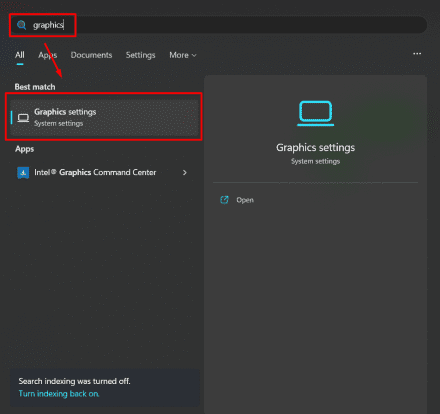
Make sure your operating system is using the best CS2 settings. To do this:
- Press the Windows key and type "Graphics" in the search bar.
Select "Graphics Settings."
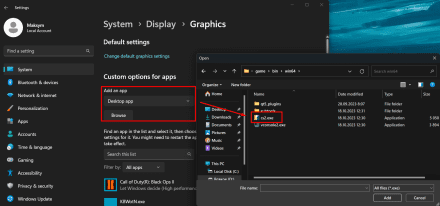
- In the dropdown menu, select "Desktop app."
- Click "Browse."
- Navigate to
steamapps\common\Counter-Strike Global Offensive\game\bin\win64. Select "CS2.exe" to close the window.
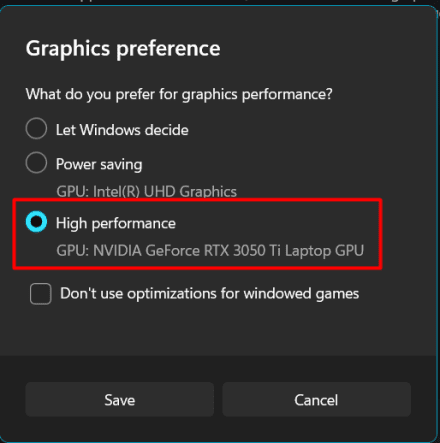
- Click on "csgo.exe" and select "Options."
Check "High performance" and click "Save."


Steam
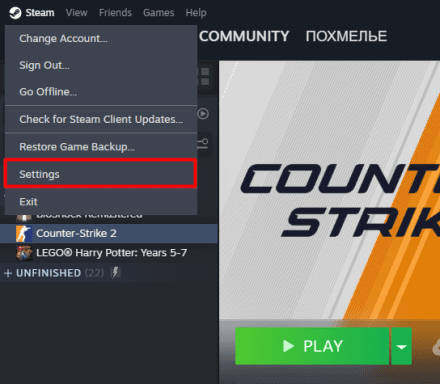
Additionally, you should configure the best CS2 settings for a low-end PC directly in Steam to further maximize performance.
Select "Settings" in the Steam application.
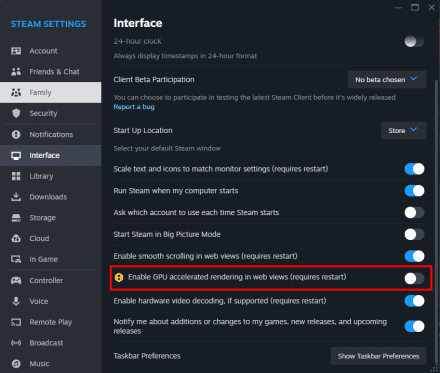
- Open the "Interface" tab.
Untick "Enable GPU accelerated rendering in web views."
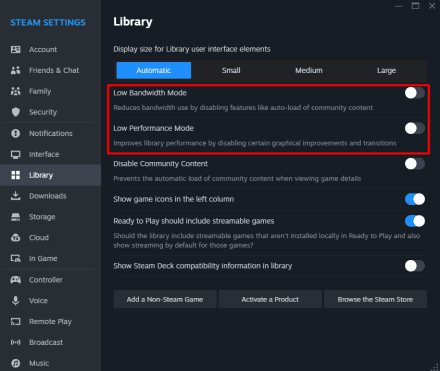
- Next, select the "Library" tab.
Tick "Low Bandwidth Mode" and "Low Performance Mode."
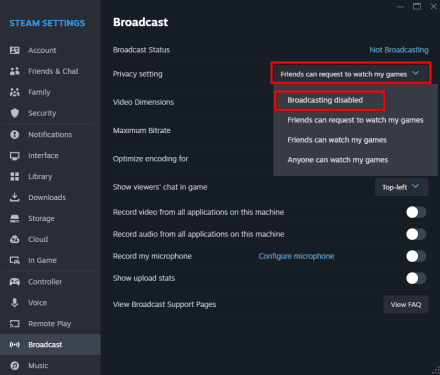
- After that, open the "Broadcast" tab.
- Select "Broadcasting disabled."
Click "OK."


CS2 Settings for Low-End PCs to Increase FPS
The CS2 low-end PC FPS boost described above allows you to maximize performance even if you are playing on very modest hardware. However, if your PC is more capable, that does not mean you should lock yourself into the lowest settings. At the same time, it also does not mean you can simply push everything to the maximum. The following requirements can deliver a three-digit FPS count, but they require careful and well-balanced configuration:
- Operating system: Windows® 10.
- Processor: 8 cores (Intel® Core™ i3-10100 or AMD Ryzen 3 3100).
- Memory: 12 GB RAM.
- Graphics: 3 GB or more with support for Shader Model 5.1 (NVIDIA RTX 1060 or Radeon RX 580).
- DirectX: Version 12.
- Storage: 85 GB available space.

To achieve a stable 100 FPS for such a system, you will need to fine-tune several parameters by applying the best CS2 settings for FPS:
- Resolution: 1660x900 (or 1920x1080 maximum).
- Refresh rate: Maximum supported by your monitor.
- Display Mode: Fullscreen.
- Laptop Power Savings: Disable.
- Boost player contrast: Enabled.
- V-Sync: Disabled.
- NVIDIA Reflex Low Latency: Enabled.
- Maximum FPS in Game: 100.
- Maximum FPS in Menus: 60.
- Current video values preset: Low/Medium.
- Multisampling Anti-Aliasing Mode: None/CMAA2.
- Global Shadow Quality: Low/Medium.
- Dynamic Shadows: All.
- Model / Texture Detail: Low/Medium.
- Texture Filtering Mode: Bilinear/Trilinear.
- Shader Detail: Low.
- Particle Detail: Low/Medium.
- Ambient Occlusion: Disabled.
- High Dynamic Range: Performance.
If these CS2 graphics settings for a low-end PC still do not resolve stuttering or performance issues, we recommend considering an upgrade and choosing a PC that is better suited for CS2, ensuring a smooth and enjoyable experience without lag.
FAQ
If you played CS:GO before switching to CS2, it is completely normal to feel that the game is laggier. The transition to the new engine introduced significant visual and technical upgrades, and many systems that ran Global Offensive smoothly are no longer sufficient for CS2. If you are looking for ways on how to optimize CS2 for a low end PC, applying the settings outlined in this guide can help improve FPS and overall performance.
Valve’s CS2 updates usually have minimal impact on overall performance. Once you determine how to play CS2 on a low-end PC and settle on stable, optimized settings, you are likely set until a major engine or version update is released.








Safronovych Kyrylo