Cache CS2 Guide: Map Features, Strategies & Setup
Contents
- History and Transition to CS2
- Cache Map Layout and Key Spots
- Main Areas of the Cache Map: Mid, A, B, and Connector Routes
- Mid
- A Bombsite
- B Bombsite
- Other Crucial Locations
- Cache Map Visual and Structural Changes in CS2
- A Site
- B Site
- Mid
- Connector/Z
- s1mple’s graffiti
- How 2025 Cache Map Changes Affect Gameplay (sightlines, rotations, control)
- Clearer visibility for both teams
- Faster rotations between sites
- Balanced Connector and more open Mid duels
- Cache Map Strategies and Control Fundamentals
- Setup & How to Play Cache in CS2 (Workshop)
- FAQ

Well, finally! Cache is back in CS2, but with elevated changes that will definitely make your gameplay memorable. Now, are you ready to learn all about its new exterior, tips, and tricks? Keep reading our comprehensive CS2 Cache map guide to discover the intricacies of its features, strategies, and setups that can boost your chances of winning every match!
History and Transition to CS2
When it comes to the Cache map overview, its story could be brief, yet it’s rich and colorful. Set in the shadows of Chernobyl, Cache is a bomb defusal map that impresses players with its unique and well-balanced layout, combining tight angles and open spaces.
Community artist Salvatore "Volcano" Garozzo first created the map back in 2011 as a custom design for the Source version. Although it featured an exciting Eastern European industrial aesthetic and fast-paced gameplay, the layout was initially heavily T-sided, giving attackers a strong advantage due to the map’s early design.
Later, artist Shawn "FMPONE" Snelling joined the project to remaster and rebalance the fan favorite. He released the redesigned version of Cache for Counter-Strike: Global Offensive in 2012. With several essential changes, FMPONE significantly improved the map's balance. As a result, Valve selected this updated Cache for Operation Bravo in 2013, a major recognition for community-made maps.
Cache's popularity skyrocketed. When Operation Breakout launched in 2014, the map was officially added to competitive matchmaking, marking a historic milestone as the first and only community-made map to enter the Active Duty Map Pool. Up until 2019, professional teams played Cache in every major CS:GO tournament. It stood out as one of the most balanced maps, supporting advanced tactics, creative plays, and unforgettable clutches.
Cache’s removal from the competitive pool on March 29, 2019, came as a shock to fans. Its replacement, Vertigo, disappointed, while FMPONE took the opportunity to rework Cache for a brief comeback in a later update.
After the release of CS2, the same artist rebuilt Cache from scratch. Since March 3, 2025, the new version has been available for anyone to play. The new still maintains its Soviet industrial aesthetic and the Chernobyl-inspired atmosphere, but with enhanced detail. Yet, the interiors of the ghost town in Pripyat are now brighter and more immersive, featuring redesigned old furniture and stained glass adorned with more vibrant artwork.
Cache Map Layout and Key Spots

Main Areas of the Cache Map: Mid, A, B, and Connector Routes
To quickly understand callouts and rotations, check out a list of common map location names that players use on Cache.
Mid
We’ll start our Cache CS2 guide by saying: those who control Mid, control the game. It’s your key area for both sides when it comes to winning rounds on Cache. Holding Mid allows CTs to execute early aggression and gain full utility control over their opponents, while Ts benefit from excellent split potential. Mid is accessible for CTs through the Highway and Connector, and for Ts through the Garage.

A Bombsite
This plant is highly exposed and visible from multiple strategic angles. Whether you’re attacking, defending, or retaking it, pay close attention to A Main, Forklift, and Highway. Since it’s perfect for both fakes and retakes, success here depends on well-coordinated grenade usage and decisive rush entries.

B Bombsite
This site is trickier, enclosed and tucked inside the brick walls of a production facility. Beware of tight choke points and awkward angles. Duels here are chaotic and demand precise aim. For Ts, however, B is often a better choice for post-plant clutches. Counter-Terrorists will struggle to retake it, but Ts should stay alert of CTs’ rotations through Heaven and CT Spawn.

Other Crucial Locations
- Key choke points: A Main, Highway, Vents, B Ramp, CT Spawn, and T Garage.
- Toxic (A Site): A sneaky post-plant hiding spot.
- Boost (Mid): Gain control here to gather early-round intel on your opponents.
- Vents (Mid/Checker): A rotational route between Mid and B.
- Heaven (B Site): One of the most powerful angles for defending the Site.
Cache Map Visual and Structural Changes in CS2
The CS2 Cache rework rework brought a long list of visual and structural upgrades. Let’s break them down.
A Site
It’s not just this callout, but the overall CS2 Cache map layout now has more natural lighting. Also, the tank on the A Site we used to surf on in CS:GO is gone.

B Site
The B Site has grown significantly. New smoke lineups and a barrel in the left corner under Heaven have been added. R.I.P. the Lamp. The changes now allow you to flash both B Main and A Main, which makes life more complicated for AWPers. Overall, there are more tight choke points here.

Mid
Mid is less green now but still colorful enough to be visually appealing. Honestly, it looks stunning! FMPONE also added huge white communist statues in keeping with Soviet Brutalism, which enhances the CS2 Cache map’s atmosphere. Boost has changed considerably; once a heavily T-favored spot, it’s now balanced for both sides.

Connector/Z
Previously, Connector gave CTs a big advantage in the form of a window they could peek through in CS:GO. In CS2 Cache, FMPONE removed it, leaving only a small crack in the wall for throwing nades. This reduces CTs’ ability to safely peek Boost or Mid. Still, it’s fun to enjoy new Cache visibility playing in the Connector, even though it’s less dominant now.

s1mple’s graffiti
The CS2 Cache update 2025 came as a real shock to the community due to the absence of the legendary graffiti that we all loved in CS:GO, which captured one of s1mple's most iconic career moments. Still, it’s understandable from the artist’s perspective since Valve owns the rights to that image. The historic graffiti was previously located on one of the B Site’s walls, beneath Heaven, as a tribute to s1mple's unforgettable clutch against fnatic in the ESL One Cologne 2016 semifinals.

If you want a broad picture of how Cache is structured, start with a map layout overview before diving into specific strategies.
How 2025 Cache Map Changes Affect Gameplay (sightlines, rotations, control)
Although there are no genuinely ‘life-changing’ map reworks on CS2 Cache, the updates we got still affect competitive play.
Clearer visibility for both teams
FMPONE regularly applies valuable fixes for the Cache map in CS2, such as global lighting and FPS improvements, enhanced rubble lighting at Mid and B Site, and better textures. The lighting overhaul has led to improved player visibility and performance for both teams. Reduced ambient noise volume and frequency have also helped enhance sound perception.
Faster rotations between sites
The map now offers smoother gameplay. The upper floor is more open, and some boxes and crates have been removed. With the new layout and additional wallbang angles, players now have more room for quick and easy movement. This gives both sides the opportunity to practice unique and effective tactics for leveraging grenades.
Balanced Connector and more open Mid duels
Removing the ladder and window in Connector ("Z") and replacing them with a small wall gap for throwing grenades significantly changed how both CTs and Ts play Mid. This adjustment balanced the power dynamics and eliminated disruptive angles that previously affected the overall game flow. Instead of instantly shutting down the Ts’ offense, Counter-Terrorists now must rely on traditional Cache tactics that reward intelligent utility usage and diverse duel positioning.
Cache Map Strategies and Control Fundamentals
For both sides to maintain effective game control, the key elements to focus on are Cache map positions, rotations, and utility management.
T-Side Approach & Priorities
Early round focus
During the first five to seven seconds of a round, rush to the Mid and A Main to pressure your opponents. Cache Mid control is what empowers you to dictate the pace of the round. Keep noise to a minimum so CTs watching Mid can’t track careless Ts moving toward B. When entering the Vents, throw a grenade to mask the breaking sound. Send your lurks through A Main or Sunroom.
Using utility to gain space
Always buy smokes, flashes, HEs, and Molotovs to gain access and control the choke points. Smoke Connector and molly Vent Room if you’re pushing A Site from Mid, or smoke and flash Mid before entering Vents for a B push.
Smoking Balcony on A won’t save you from CTs hiding there, as they can still regain vision of the site by maneuvering out of the smoke range. To execute A, smoke Truck and molly Forklift. When executing a B split via Vents, smoke CT and flash into Site.
Using smart smoke tactics can make a big difference — try some of these key smoke strategies for better utility usage.
Split attacks and rotations
Mind your rotations and foster exceptional teamwork, as communication is vital. Playing with your opponents’ expectations and messing around with timings will serve you well here. So, time your attacks either very late in the round, as NAVI often does, or go for quick aggression. For instance, late-round B splits through the Vents remain a strong and reliable choice.
If you decide to rush B, ensure your push is perfectly timed (to avoid utility damage) and that your first entry players are your best aimers. This setup allows your team to eliminate CTs on Rafters with accurate smokes and clean shots, while staying safe from those in Generator, who your teammates should suppress from Checkers.
CT-Side Defense & Retake Philosophy
Holding main zones (A, B, and Mid)
A common Cache map setup the T-Side involves a lurker hitting B Site as soon as the main push begins on A. It either makes a Counter-Strike player on B late to rotate or endangers CTs to being flanked from the Tree Room. A solid solution is keeping your B teammate in Heaven or Tree, delaying enemy rotations to A for as long as possible.
An advanced pro-level Cache map setup uses a 1-3-1 formation across A-Mid-B. One CT player anchors A from Fence or Quad; another guards Checkers on B, playing passively; one Mid player pressures Vent side; and the last covers Boost from Z or Sandbags. You can also boost a CT into Vent to support both Mid and B, providing strong crossfire options and angles to catch Ts pushing into Checkers.
Otherwise, identify your opponents’ tendencies and shut down their most common approaches. If Ts frequently push Mid, smoke it early and throw a Molotov behind the smoke to stall them even further.
Crossfire, anchor positioning, and Mid rotations
CS2 Cache emphasizes next-level team coordination and communication. Make sure that all entry points are covered and every player knows how to use their utility effectively.
When two or three players defend Mid, each should choose anchor positions that allow mutual support when Ts rush through. Simultaneously, have one player take control of the Vents to set up a crossfire with a teammate holding under Boost, and a third player anchors Connector, White Box, or Sandbags. Running a three-Mid setup helps you avoid losing manpower when rotating quickly between sites.
Play mind games, stay unpredictable and be sharp about immediate decision-making mid-round. Pay attention to noticing how your opponents move and where their lurker operates. Always maintain strong positions that allow safe rotations, communicate clearly about your movements, and call rotations early. For instance, a Highway player can rotate to Mid when you move to B, or a B defender can shift to Mid when A needs backup.
When to give up space vs. When to contest Mid
If you fail to take control of Mid early in the round, reposition deeper on Highway, especially if your opponents tend to hit the A Site more often. Holding A solo is almost always a losing play unless you stacked it at the start of the round. So, it’s smarter to let your enemy pass through the Mid and then retake A post-plant.
Both sites on CS2 Cache offer at least one point of elevation that CTs can use for holding or retaking. Hence, opting to retake A is often the smarter move. Focus instead on defending B and breaking up B splits with timely aggression.
Basic retake setups
When retaking A, split your team across as many entry points as possible. To retake the A Site on the Cache map in CS2, use boosts, smoke key areas like Squeaky, throw Molotovs to clear common hiding spots, and flash enemies before peeking. From the lobby, use your utility to support other teammates as they enter the site and coordinate to clear key clutch positions.
On B, pre-fire after flashing aggressive Ts, and keep an ear on what’s happening in B Main. One of the strongest CS2 Cache strategies for retaking B is to quickly flank B Main through the Mid or Vents with two players and well-timed flashes. If you manage to arrive there early, throw a Molotov from Heaven to stop the plant. You can also flash into Heaven and molly the default. Throw a smoke to block the Vent and create a safe entry route from the lobby.
Setup & How to Play Cache in CS2 (Workshop)
Now, how to play Cache in CS2? Easy as breathing! The talented FMPONE has finally uploaded CS2 Cache in the Workshop, so you can start enjoying it right now.
Access the Cache Map in CS2
Subscribe to CS2 Cache in the Steam Community Workshop Maps.
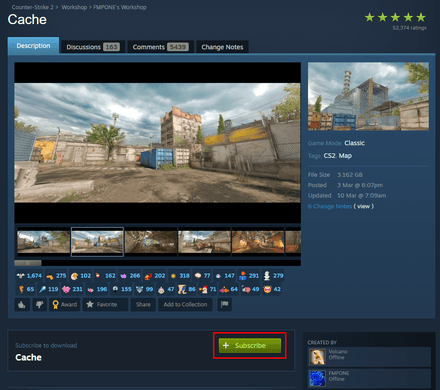
- Steam will automatically download it (about 1.8 GB), so make sure you have enough space.
Launch CS2 and choose the Workshop Maps option.
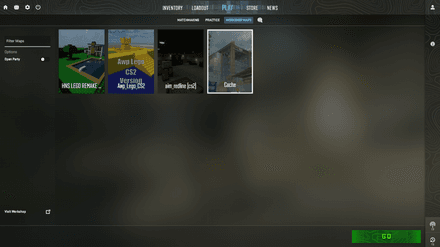
- Set up a match with friends or bots, and enjoy the game!


Practice Commands
Before jumping into matchmaking, use practice settings to get familiar with the CS2 Cache map layout and its new tweaks.
- Use helpful console commands like [sv_cheats 1], [noclip], [bot_kick], and [mp_roundtime_defuse] to accelerate your map learning journey.
- Do warm-up routines to practice quick aiming drills, grenade throws, and movement routines to build confidence before full matches.
FAQ
After downloading the map, go to the "Play" menu, then to the Community Server Browser (globe icon), and search/filter for de_cache in the server list, or use third-party platforms that aggregate all active servers.
No one knows for sure. But hopefully, given the strong community demand for the Cache map Competitive mode, there’s a good chance Valve will consider bringing it back to the official CS2 map pool.
Because players disliked the overly green color palette from CS:GO. Thus, FMPONE refreshed the visuals with golden-toned lighting and cleaner textures for better visibility.
Absolutely. Many pro players have already requested that Cache return to the Active Duty Pool. And the best way to learn the CS2 Cache map for beginners is to watch pro streams and follow their tips for the most effective setups and strategies.